
Skip to content
ForEveryone logo
  • Workshops
  • Courses
    • Clay Connection
  • EU Projects
    • What We Do
    • Toolbox For Integration
    • Peer Support & Resilience
    • SheLeads
  • Community
    • About Us
    • Partnerships
    • Events
    • Volunteer
    • Contact
    • Instagram
  • Cafe
  • Blog
  • Book a Workshop
  • Workshops
  • Courses
    • Clay Connection
  • EU Projects
    • What We Do
    • Toolbox For Integration
    • Peer Support & Resilience
    • SheLeads
  • Community
    • About Us
    • Partnerships
    • Events
    • Volunteer
    • Contact
    • Instagram
  • Cafe
  • Blog
  • Book a Workshop
ForEveryone logo
  • Workshops
  • Courses
    • Clay Connection
  • EU Projects
    • What We Do
    • Toolbox For Integration
    • Peer Support & Resilience
    • SheLeads
  • Community
    • About Us
    • Partnerships
    • Events
    • Volunteer
    • Contact
    • Instagram
  • Cafe
  • Blog
  • Book a Workshop
  • Workshops
  • Courses
    • Clay Connection
  • EU Projects
    • What We Do
    • Toolbox For Integration
    • Peer Support & Resilience
    • SheLeads
  • Community
    • About Us
    • Partnerships
    • Events
    • Volunteer
    • Contact
    • Instagram
  • Cafe
  • Blog
  • Book a Workshop
Book a Workshop
MAYDAY MAYDAY graphic with photos filling the lettering on a blue background

May 1st in Berlin: Should the May Day Party Stop?

Has true meaning of the holiday has gotten lost for the sake of hedonistic pleasure?

Picture of Maria Plexida

Maria Plexida

  • May 1, 2025

The beginning of summer, time for loved ones, demonstrations, and free parties across the city for many Berliners, May 1st is one of the most anticipated days of the year.

Originally rooted in remembrance and working-class resistance, the day has historically carried the weight of struggle: for fair labour conditions, dignity, and social justice. Today, demonstrations often take many forms from traditional marches to gatherings, raves, and collective celebrations in public space.

It is easy to assume that this shift signals a loss of meaning, replaced by hedonistic pleasure. But perhaps the reality is more complex.
The history of May Day in Berlin

We know, we’re a little late, still recovering from the festivities of last week. With the abundance of time on our hands and the sheer endless possibilities Berlin offers on May 1st, the holiday can feel like one of the longest days of the year – in a good way. Suddenly an early morning feels worth it, if it means time spent with loved ones, getting ready for a day of demos, sun and dancing.  As we’re slowly returning to the realities of a life that happens before and after a 9 to 5, we’re reminded that the fight for social equality continues far beyond May 1st.

When labour movements first took to the streets of Berlin in 1890, their demands were clear: an eight-hour workday, safer working conditions, political participation, and social equality. Known as Arbeiterkampftag, this day has remained a symbol of resistance across generations, echoed in countless demonstrations throughout the city.

While many of these traditional forms of protest continue today, new forms of gathering have emerged alongside them. What may appear as a departure from political meaning can also be understood as an expansion of what resistance looks like and where it takes place.

What are we fighting for?

Many issues the Arbeiterkampftag originally stood for are still present in today’s protests. Though the 8 hour work day has long been implemented, politics and employers still have ways to go in terms of social justice and working conditions.


While these demands deserve their spotlight, a more subtle but insidious symptom of capitalism often remains overlooked: loneliness. A system that prioritizes profit and productivity over people thrives on alienation: the loneliness epidemic of the recent years is a direct result of continued isolation – from each other, from our labour and from a sense of collective belonging.


A sense that we’re desperate to regain. As demands from traditional protests take a while to implement – we have to look for additional forms of resistance.

Community and creative expression as political acts

Although many of the parties taking place on May 1st can lack political purpose, people coming together to connect and express themselves without the need to produce is an act of resistance in itself.


Under oppressive conditions community challenges the very foundation of the system. It says: we do not exist to produce; we exist to relate, to support, and to resist together. Creative expression plays a pivotal role in this process: Through shared space, storytelling and collaboration art not only builds community, it also exposes injustice and tells marginalised stories.

How do we protest in everyday life?

As politics and employers remain slow to respond, responsibility falls on us to build infrastructures of care: refuges and platforms, that encourage to truly connect, creatively express ourselves and envision alternatives to our current conditions.


Aware of this responsibility, we strive to make ForEveryone more than just an NGO – but a community.


Through our workshops and events, we aim to create a welcoming, low-barrier environment where people from all backgrounds can come together, connect meaningfully, and explore their creative voice without pressure or pretense.


We prioritise accessibility for different income groups and actively work to amplify marginalised perspectives because we believe that joy, care, and collective expression are not luxuries, but necessities.

So, should the party stop?

Not if it continues to build solidarity. Not if it reminds us why we gather. Not if it fuels the long fight with beats, banners, and belonging.

Picture of Maria Plexida

Maria Plexida

Maria Plexida is from Greece and currently exploring the city of Berlin in her own way. She studied Journalism and love telling stories, either through text or visuals. She also plays the piano and sings. Still unsure of what she’ll choose. As for now, she is a blog writer and editor at ForEveryone :)
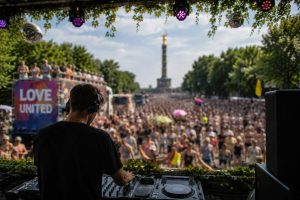
DJ performing from a music truck during the Rave the Planet Berlin 2026 parade in Berlin.
Berlin
Nadja Prytkova

Rave the Planet 2026 Guide: History, Route, Tips & What to Expect

Rave the Planet 2026 Guide: History, Route, Tips & What to Expect Planning to join Rave the Planet Berlin 2026? This guide covers everything you need to know before the

Read More »
Nadja Prytkova 5 August, 2026
ForEvyone Team outside Café Pavillon, a wooden kiosk café at Boxhagener Platz, with trees and a cobblestone street around them
Balance and Wellbeing
Meryame Benmokhchane

Why Meaningful Connections Take More Than Just Spending Time Together

Making meaningful friendships takes more than simply spending time together. In this article, we’ll explore the science behind human connection, why shared experiences matter, and how building community helps create a lasting sense of belonging whether you’re new to Berlin or simply looking to connect.

Read More »
Meryame Benmokhchane 9 July, 2026
Handbuilt pottery pieces created during a beginner pottery workshop at ForEveryone Berlin.
Arts and Crafts
Nadja Prytkova

Berlin Pottery Workshops in English: Affordable Classes for Beginners

Looking for an affordable ceramic workshop Berlin for beginners? Discover English-speaking pottery workshops, compare studios and prices, and find pottery classes in Berlin for expats who want to get creative, meet people, and learn pottery in a welcoming environment.

Read More »
Nadja Prytkova 30 June, 2026

The beginning of summer, time for loved ones, demonstrations, and free parties across the city for many Berliners, May 1st is one of the most anticipated days of the year.

Originally rooted in remembrance and working-class resistance, the day has historically carried the weight of struggle: for fair labour conditions, dignity, and social justice. Today, demonstrations often take many forms from traditional marches to gatherings, raves, and collective celebrations in public space.

It is easy to assume that this shift signals a loss of meaning, replaced by hedonistic pleasure. But perhaps the reality is more complex.

Image by Markus Spiske on Unsplash

We know, we’re a little late, still recovering from the festivities of last week. With the abundance of time on our hands and the sheer endless possibilities Berlin offers on May 1st, the holiday can feel like one of the longest days of the year – in a good way. Suddenly an early morning feels worth it, if it means time spent with loved ones, getting ready for a day of demos, sun and dancing.  As we’re slowly returning to the realities of a life that happens before and after a 9 to 5, we’re reminded that the fight for social equality continues far beyond May 1st.

When labour movements first took to the streets of Berlin in 1890, their demands were clear: an eight-hour workday, safer working conditions, political participation, and social equality. Known as Arbeiterkampftag, this day has remained a symbol of resistance across generations, echoed in countless demonstrations throughout the city.

While many of these traditional forms of protest continue today, new forms of gathering have emerged alongside them. What may appear as a departure from political meaning can also be understood as an expansion of what resistance looks like and where it takes place.

What are we fighting for?


Many issues, the Arbeiterkampftag originally stood for, are still present in today’s protests. Though the 8 hour work day has long been implemented, politics and employers still have ways to go in terms of social justice and working conditions. While these demands deserve their spotlight, a more subtle but insidious symptom of capitalism often remains overlooked: loneliness.

A system that prioritizes profit and productivity over people thrives on alienation: The loneliness epidemic of the recent years is a direct result of continued isolation – from each other, from our labour and from a sense of collective belonging. A sense that we’re desperate to regain. As demands from traditional protests take a while to implement we have to look for additional forms of resistance. 


Community and creative expression as political acts


Although many of the parties taking place on May 1st may lack political purpose, people coming together to connect and express themselves without the need to produce is an act of resistance in itself. Under oppressive conditions community challenges the very foundation of the system. It says: we do not exist to produce; we exist to relate, to support, and to resist together. Creative expression plays a pivotal role in this process: Through shared space, storytelling and collaboration art not only builds community, it also exposes injustice and tells marginalized stories. 


How do we protest in everyday life?


As politics and employers remain slow to respond, responsibility falls on us to build infrastructures of care: Refuges and platforms, that encourage to truly connect, creatively express ourselves and envision alternatives to our current conditions. 


Aware of this responsibility, we strive to make our space at No.52 more than just a studio — but a community through our workshops and events, we aim to create a welcoming, low-barrier environment where people from all backgrounds can come together, connect meaningfully, and explore their creative voice without pressure or pretense. We prioritize accessibility for different income groups and actively work to amplify marginalized perspectives because we believe that joy, care, and collective expression are not luxuries, but necessities.


So, should the party stop?

Not if it continues to build solidarity. Not if it reminds us why we gather. Not if it fuels the long fight with beats, banners, and belonging.

ForEveryone logo
ForEveryone logo

Not your average newsletter: heartfelt, human, happy

Explore

  • Workshops
  • Courses
  • EU Projects
  • About Us

Support

  • Volunteer
  • Partner With Us
  • Cafe
  • Blog

Contact

  • Contacts
  • hello@foreveryone.berlin
  • No.52 Cafe, Grünberger Str. / Ecke, Gärtnerstraße, 10245 Berlin

Not your average newsletter: heartfelt, human, happy

© 2026 ForEveryone. All rights reserved.      Privacy       Impressum

© 2026 ForEveryone. All rights reserved.      Privacy      Impressum
We use cookies

We use cookies to enhance your experience and analyze traffic, as explained in the Cookie Policy.

Functional Always active
The technical storage or access is strictly necessary for the legitimate purpose of enabling the use of a specific service explicitly requested by the subscriber or user, or for the sole purpose of carrying out the transmission of a communication over an electronic communications network.
Preferences
The technical storage or access is necessary for the legitimate purpose of storing preferences that are not requested by the subscriber or user.
Statistics
The technical storage or access that is used exclusively for statistical purposes. The technical storage or access that is used exclusively for anonymous statistical purposes. Without a subpoena, voluntary compliance on the part of your Internet Service Provider, or additional records from a third party, information stored or retrieved for this purpose alone cannot usually be used to identify you.
Marketing
The technical storage or access is required to create user profiles to send advertising, or to track the user on a website or across several websites for similar marketing purposes.
  • Manage options
  • Manage services
  • Manage {vendor_count} vendors
  • Read more about these purposes
Preferences
  • {title}
  • {title}
  • {title}