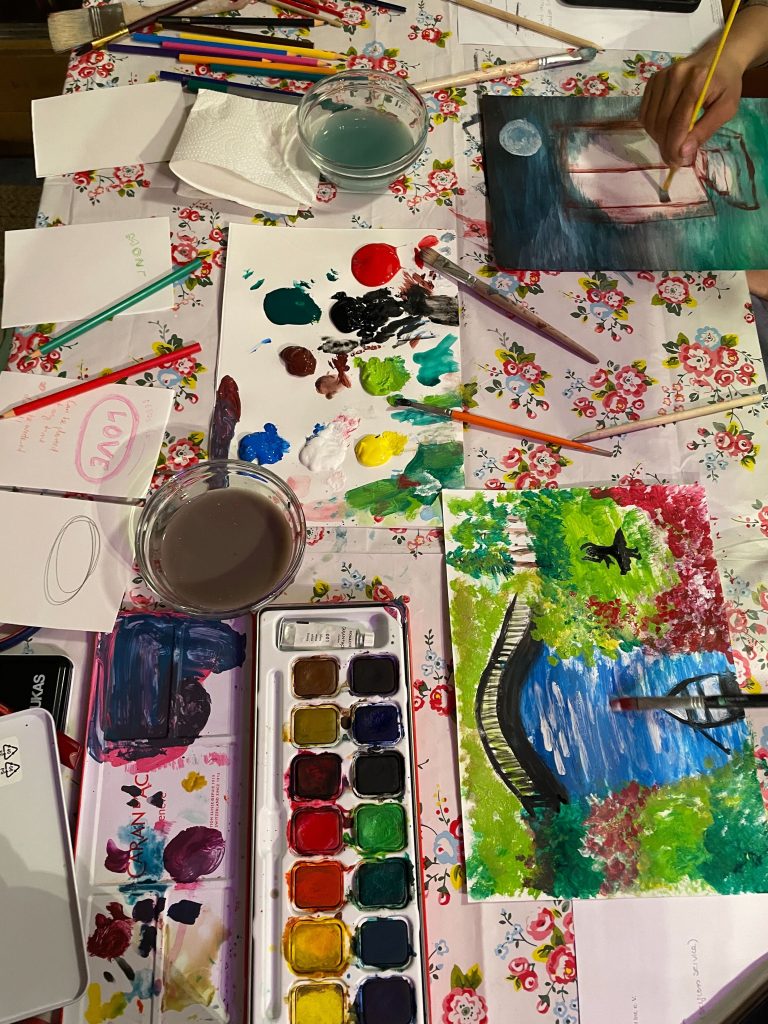
“What if you didn’t need the right words, or any words at all, to say exactly what you feel? Art as Communication allows emotions, ideas, and experiences to be expressed beyond language”.
Moving to a new city is one of those experiences that sounds exciting until you’re actually living it. Berlin is green, full of things to do, easy to explore, and for the first few weeks, it all feels like an adventure. But then the tourist phase fades, and if you haven’t found your people yet, your routine, your circle, your place, the city’s beauty can feel strangely hollow, especially in winter.
There’s a particular kind of loneliness that comes with leaving everything familiar behind: your friends, your rhythms, your language and sometimes, you can’t quite put it into words.
That’s where art comes in, not the kind you study in school, not the kind that hangs in galleries, but the kind that happens when you just pick up a brush and let something out.
What Is Expressive Painting?

ForEveryone Workshop November 2025
Expressive Painting is not about technique. It’s not about making something beautiful or getting it right. It’s about using color, movement, and mark-making as a way to express what’s happening inside you, the stuff that’s hard to say out loud.
Think of the difference between learning a language to pass an exam and speaking to a close friend in your mother tongue. One is performance, the other is communication. Expressive painting is the second one, you’re not trying to impress anyone, you’re just speaking, in the most honest way you can through a different medium.
Technical art asks: Is this right? Expressive art asks: Does this feel true? That shift, from performance to expression, is everything.
Why Art Is a Powerful Form of Communication
There’s a reason therapists have used art as a tool for decades. Some emotions don’t fit into sentences. Grief, confusion, that restless feeling you can’t name at 11pm on a Tuesday. Words often fall short. When language isn’t enough, the body finds other ways.
Neuroscience backs this up: creative expression engages your sensory system, your memory, and your emotional processing all at once. The hand moving across the canvas becomes a kind of thinking, you often don’t know what you felt until you see what you made and there’s something else, art doesn’t just release emotion, it creates connection. When you sit in a room with other people and create something together, even in silence, something shifts.
You’re sharing an experience, that shared vulnerability, that gentle “we’re all in this together” feeling, can be more powerful than any conversation.
Emotional Benefits of Expressive Painting
Stress Relief and Emotional Release
When you pick up a brush, your nervous system gets a break from the noise. A study by
Kaimal, Ray & Muniz found that 75% of participants had measurably lower cortisol levels after just 45 minutes of art-making, regardless of their skill level. You don’t need to be good at it. You just need to show up.
Increased Self-Awareness
One of the quieter gifts of expressive painting is what it shows you about yourself. The colors you reach for, the lines you make, the parts of the canvas you avoid, it’s all information. Many people describe stepping back from a piece and feeling surprised by what came out. It’s like holding up a mirror that doesn’t judge, just reflects.
Processing Difficult Emotions
Psychologists call this “externalizing,” giving an inner feeling a form outside yourself. When a difficult emotion has a shape or color on paper, it becomes something you can look at rather than something that’s consuming you. Research on expressive arts therapy shows meaningful reductions in trauma symptoms and emotional overwhelm, particularly in group settings.
How to Start Expressive Painting (Even If You're a Beginner)
Here’s the most important thing to know before you start: there are no rules. Expressive painting is not about skill, if you approach it trying to make something good, you’ll get in your own way.
The goal is to get out of your head and into the moment. You don’t need much to begin:
• Acrylic or watercolor paints
• A few brushes in different sizes
• Paper or canvas board
• A cup of water
• No plan required
Try this: before you pick up a brush, close your eyes for a moment. Notice how you feel right now. Not how you think you should feel, just what’s actually there.
Then choose a color that feels right for that. Just one. Start there. See what happens.
You can paint with music or in silence. You can use your fingers if a brush feels too deliberate. There’s no wrong move.
Want to try it with others?
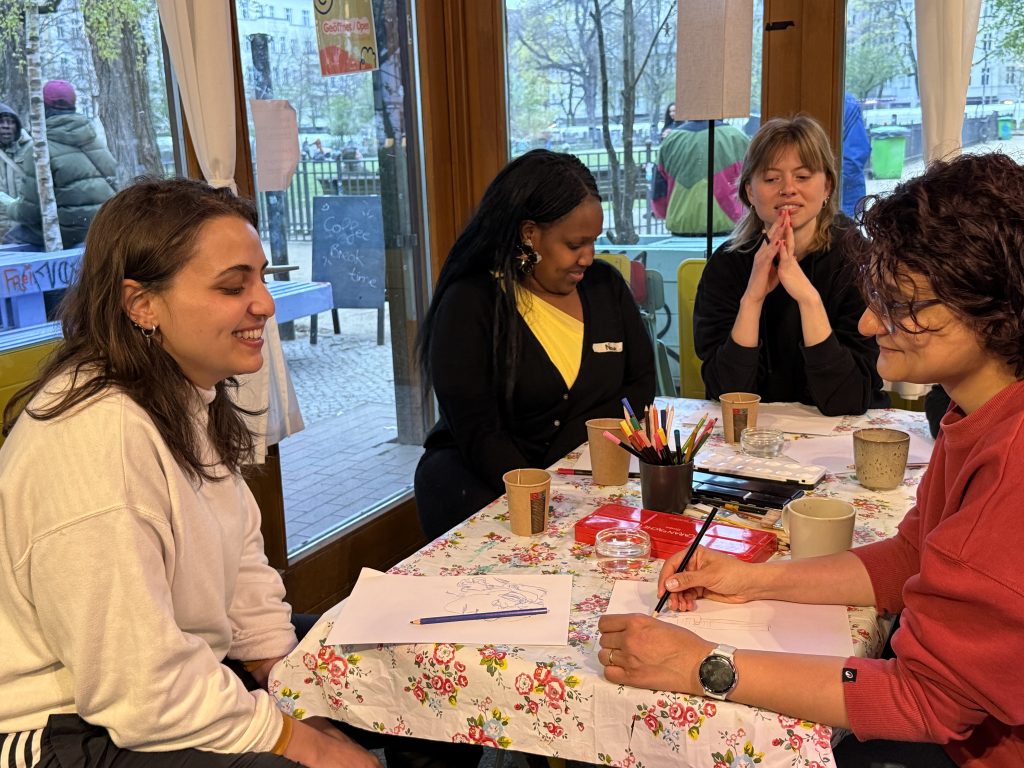
Come to join us for the next Expressive Painting lead by Lacy, an Art Therapist.
Every Thursdays at No. 52 Cafe in Boxhagener Platz, Berlin from 18:00 to 19:15.
No experience needed, just your curiosity and willingness to try something new.
You’ll be in a room full of people who feel exactly the same way.
No judgment. No pressure. Just paint, presence, and good company.
Reserve your spot HERE
Painting as a Form of Self-Care
Self-care has become a word that gets thrown around a lot, often attached to expensive
routines or products. But at its core, self-care is simply the practice of giving yourself what you need. And sometimes, what you need is an hour where you’re not optimizing, not producing, not performing. Just being.
Building a small creative ritual into your week, even once a month, can anchor you. Research on mindfulness shows that repetitive, rhythmic hand movements activate the parasympathetic nervous system, the one that tells your body it’s safe to slow down. Color influences mood, warm tones energize, cool tones calm. And the simple act of choosing what goes on the page returns a quiet sense of agency.
For people living with anxiety, this kind of structured-but-free creative practice can be particularly grounding. It gives the mind something to focus on that isn’t a problem to solve.